Turboprops and light jets are both capable aircraft for short- to medium-range missions, and they are often evaluated against each other by buyers who fly routes of 500 to 1,500 nm, carry 4–8 passengers, and want to access smaller airports. The two categories differ in propulsion, speed, cabin environment, airport access, and ownership economics — and neither is universally superior. The right choice depends on the buyer's specific routes, passenger requirements, and operational priorities.
This comparison explains how the categories differ, identifies the missions where each type has a meaningful advantage, and highlights the ownership considerations that are most relevant to buyers evaluating both options. Named aircraft examples are used where they help clarify the discussion; buyers should verify specifications for any specific aircraft they are considering.
How the categories differ
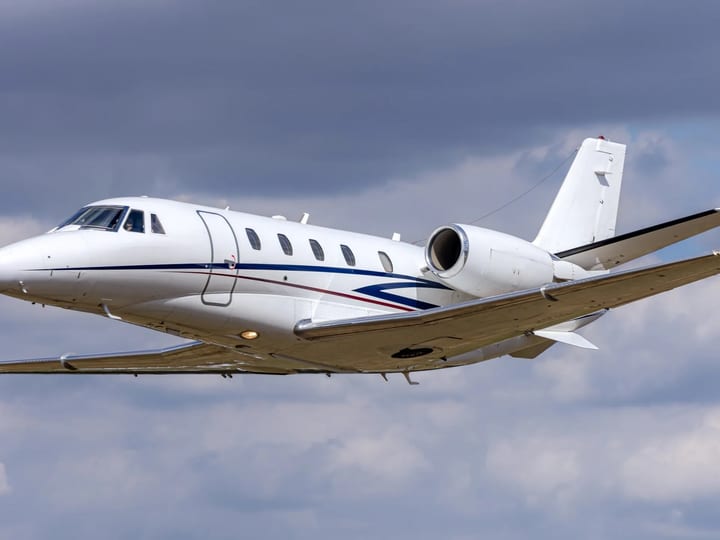
A turboprop aircraft uses one or more turbine engines to drive a propeller. Common examples in the business aviation market include the Pilatus PC-12, the Daher TBM series, and the Beechcraft King Air series. A light jet uses one or more turbofan or turbojet engines and does not have a propeller. Common examples include the Cessna Citation CJ series, the Embraer Phenom 100 and 300, and the HondaJet.
The propulsion difference has practical consequences. Turboprops are generally slower than light jets at cruise altitude but can operate efficiently at lower altitudes and are often more fuel-efficient on shorter routes. Light jets cruise faster and at higher altitudes, which can reduce block times on routes of 500 nm or more. The speed advantage of a light jet is more meaningful on longer routes; on very short routes of 200–300 nm, the difference in block time may be modest after accounting for taxi, climb, and descent.
Representative specifications
The table below shows representative specifications for well-known examples in each category. These figures are for illustration only — individual aircraft within each category vary significantly. Buyers should verify specifications for any specific aircraft they are evaluating.
| Specification | Pilatus PC-12 NGX (turboprop) | Phenom 300E (light jet) |
|---|---|---|
| Propulsion | Single turboprop (PT6A-67P) | Twin turbofan (PW535E1) |
| Published range (NBAA IFR reserves) | Approx. 1,803 nm | Approx. 2,010 nm |
| Maximum cruise speed | Approx. 290 kt TAS | Approx. 453 kt TAS |
| Maximum operating altitude | 30,000 ft | 45,000 ft |
| Cabin length (excl. baggage) | Approx. 16 ft 8 in | Approx. 17 ft 2 in |
| Cabin width | Approx. 5 ft 1 in | Approx. 5 ft 1 in |
| Typical passenger seating | 6–9 | 6–8 |
| Baggage volume | Approx. 53 cu ft (internal) | Approx. 84 cu ft (internal + external) |
| MTOW | Approx. 10,450 lb | Approx. 17,968 lb |
| Takeoff distance (MTOW, ISA, sea level) | Approx. 2,690 ft | Approx. 3,138 ft |
Sources: Pilatus PC-12 NGX specifications (pilatus-aircraft.com); Embraer Phenom 300E specifications (embraer.com). These are representative examples; other turboprops and light jets have different specifications. Reviewed November 2026.
Speed and block time
Light jets cruise significantly faster than turboprops. A typical light jet cruises at 400–460 kt; a typical turboprop cruises at 260–330 kt. On a 500 nm route, that speed difference translates to roughly 30–45 minutes of additional flight time in a turboprop. On a 1,000 nm route, the difference grows to 60–90 minutes.
However, block time is not the same as flight time. Turboprops can often depart and arrive at smaller airports that are closer to the passenger's origin and destination, which can reduce ground transportation time. In some cases, the turboprop's ability to use a closer airport offsets part or all of the speed disadvantage. Buyers should evaluate total door-to-door time for their specific routes, not just cruise speed.
Airport access
Turboprops generally have shorter takeoff and landing distances than light jets, which allows them to access a wider range of airports, including shorter grass or unpaved strips that light jets cannot use. Single-engine turboprops such as the PC-12 can operate from very short runways — under 2,700 ft in some configurations — that are inaccessible to most jets. This airport access advantage is most relevant for buyers who regularly fly to remote destinations, mountain airports, or smaller regional facilities.
Light jets require longer runways than turboprops but can still access many general aviation airports that larger jets cannot. Buyers who fly primarily between well-served airports with runways of 4,000 ft or more will find that most light jets can serve their routes without significant airport access limitations.
Cabin environment and baggage
Cabin dimensions in the turboprop and light jet categories are broadly similar — both typically offer cabins of 5–6 ft wide and 4.5–5 ft tall, with seating for 6–9 passengers. The cabin environment in a light jet is generally quieter than in a turboprop, because turboprops produce more propeller noise and vibration. Buyers who are sensitive to cabin noise or who regularly carry passengers who value a quieter environment may prefer a light jet.
Baggage capacity varies by aircraft. Some turboprops, such as the PC-12, offer a large rear cargo door that allows oversized items to be loaded — an advantage for buyers who carry sporting equipment, medical supplies, or other bulky cargo. Most light jets have external baggage compartments that are accessible only on the ground, with limited internal storage.
Ownership economics
Turboprops are generally less expensive to acquire and operate than light jets, though the difference varies significantly by specific aircraft, age, and configuration. A new single-engine turboprop such as the PC-12 or TBM 960 typically has a lower acquisition price than a new light jet such as the Phenom 300E or Citation CJ4. Operating costs — fuel, maintenance, crew, and insurance — are also generally lower for turboprops, particularly single-engine models.
However, blanket cost comparisons between categories are unreliable. A well-maintained pre-owned light jet may have lower total ownership costs than a poorly maintained turboprop. Buyers should obtain a detailed operating cost analysis for any specific aircraft they are considering, including fixed annual expenses and variable costs per flight hour.
Single-engine turboprops have a different regulatory and insurance profile than twin-engine jets. Some operators require twin-engine aircraft for certain operations, and insurance costs for single-engine aircraft may differ from twin-engine alternatives. Buyers should discuss their operational requirements and insurance considerations with their aviation advisor before making a purchase decision.
Understanding the full cost of aircraft ownership before you buy is essential. Bencasso's aircraft ownership cost resources cover fixed annual expenses, variable operating costs, and major capital events across aircraft categories.
Aircraft Ownership CostsWhen a turboprop may be the better fit
- Routes of 500 nm or less where speed advantage is modest and airport access matters more
- Operations from short, unpaved, or remote airstrips that light jets cannot access
- Missions requiring large or oversized cargo that benefits from a rear cargo door
- Buyers who prioritize lower acquisition and operating costs over speed
- Operations in regions where single-engine turboprop certification is accepted
When a light jet may be the better fit
- Routes of 500–2,000 nm where cruise speed meaningfully reduces block time
- Passengers who value a quieter, smoother cabin environment
- Operations primarily from airports with runways of 4,000 ft or more
- Buyers who want higher cruise altitude for weather avoidance
- Missions where twin-engine redundancy is required or preferred
Conclusion
Turboprops and light jets are both capable aircraft for short- to medium-range missions, and neither is universally superior. The right choice depends on the buyer's specific routes, airport requirements, passenger preferences, and ownership economics. Buyers who regularly fly to remote or short-runway airports, carry oversized cargo, or prioritize lower operating costs may find a turboprop more suitable. Buyers who value speed, a quieter cabin, or higher cruise altitude may prefer a light jet. A careful analysis of the buyer's actual mission requirements is the most reliable basis for the decision.
Bencasso Air Group provides independent buyer representation for turboprop and light jet acquisitions, from mission analysis and aircraft sourcing through due diligence, negotiation, and closing.
Aircraft Acquisition ServicesFrequently asked questions
Are turboprops always cheaper to operate than light jets?
Not always. While turboprops are generally less expensive to acquire and operate than light jets of comparable size, the actual cost difference depends on the specific aircraft, age, maintenance status, utilization, and operating environment. A well-maintained pre-owned light jet may have lower total ownership costs than a poorly maintained turboprop. Buyers should obtain a detailed operating cost analysis for any specific aircraft they are considering.
Is a single-engine turboprop safe for passenger operations?
Modern single-engine turboprops such as the Pilatus PC-12 and Daher TBM series have strong safety records and are certified for single-pilot IFR operations. However, some operators, charter regulations, and insurance policies require twin-engine aircraft for certain operations. Buyers should discuss their operational requirements and insurance considerations with their aviation advisor before choosing a single-engine aircraft.
Can a turboprop fly as high as a light jet?
Most turboprops have a lower maximum operating altitude than light jets. A typical turboprop operates at 25,000–30,000 ft; a typical light jet operates at 41,000–45,000 ft. The higher cruise altitude of a light jet allows it to fly above most weather and take advantage of favorable winds at altitude. For buyers who frequently encounter convective weather or who fly long routes where altitude matters for efficiency, the light jet's higher ceiling is a meaningful advantage.
What is the best turboprop for business travel?
There is no single best turboprop for all buyers. The Pilatus PC-12 is widely regarded as one of the most capable single-engine turboprops for business travel, offering a large cabin, long range, and excellent short-field performance. The Daher TBM series offers higher speed in a single-engine turboprop. The Beechcraft King Air series offers twin-engine reliability in a turboprop platform. The right choice depends on the buyer's specific mission, passenger requirements, and operational priorities.
How do I decide between a turboprop and a light jet?
The most reliable approach is to define your mission requirements first — typical routes, passenger counts, airport requirements, and flight frequency — and then evaluate each aircraft category against those requirements. An independent aviation advisor can help you model the performance, cost, and operational implications of each option before you commit to a specific aircraft.